
November 2026: Chipping Away at the Public Commons, Light Pollution News
This is a fun one! What happens when you shield your lights? Well, it looks like a win for insects! We learn about how a Belgian national park was able to remove 79 streetlights with community buy in! And what if I told you that there was a community 30 miles outside of town that wants to preserve the night sky?
Guest Lineup
Host
-

Bill McGeeney
Guests
-
Ari Isaak
EvariLABS
Ari Isaak spent 25 years as a Geographic Information Systems (GIS) professional and came to lighting through asset management. He founded Evari Consulting in 2011, just as LED conversion was beginning, and led field operations and data management on large street lighting conversion projects including Chicago, Phoenix, San Diego, Philadelphia and Boston. Ari worked alongside lighting designers to determine which luminaire would be installed at each location. In 2024 he stepped away to start EvariLABS, which builds civil lighting design software. Its first product, EvariLUX, has run photometric calculations on ~450,000 street lights. He holds two issued U.S. patents, is a GISP and CFLC, and serves on the IES Roadway Lighting Committee.
-
Joshua Sokol
Author, Freelance Journalist
Joshua Sokol is a science journalist based in North Carolina. A contributor to The New York Times, Science, Scientific American, and other publications, his stories have been recognized by the Best American Science and Nature Writing, The Best Writing on Mathematics, the American Astronomical Society, the American Institute of Physics, and the American Geophysical Union. His upcoming popular science book The Once and Future Night: How We Loved and Lost the Stars, out April 2027 for Random House, traces the cultural and environmental history of the starry sky and makes a case for its preservation.
-
Nicolas Goethals
Parc-National-Entre-Sambre-et-Meuse
Background in social and environmental sciences, nature guide. Working at Entre-Sambre-et-Meuse national park in the nature team on night projects and coordination of research. Worked on the fundamentals of a “black frame project”, 2023-2026, in the national park, and now coordinating a european Interreg Wallonia-France-Vlaanderen project called “TAMISEE” (2026-2029) as the Entre-Sambre-et-Meuse national park is project leader


Summary
November Highlights
A Causal Comparison between Tiger Mosquito Insecticide Resistance and Light Pollution
Guest Joshua Sokol’s Substack, Once and Future Night, argues that the trouble with mosquitoes and the trouble with light pollution stem from the same causal thinking.
Nature Reviews Biodiversity Review Says Measuring Ecological Light Pollution Is Still Difficult Even as Understanding of Biological Effects Matures
A five-year review in Nature Reviews Biodiversity finds ecological light pollution is still hard to measure because the tools were built for human rather than animal or plant questions, even as the biology firms up: melatonin is the marker for vertebrates, and nocturnal, migratory, large-eyed species are hit hardest. Artificial light also compounds chemical pollution, warming, and noise, and regulation remains fragmented, with mitigation still ordered as elimination, lighting controls, then tuning.
Entre-Sambre-et-Meuse National Park in Belgium Plans to Switch Off 79 Streetlights to Build a Dark Network for Nocturnal Wildlife
Entre-Sambre-et-Meuse National Park in southwestern Belgium is turning off some 79 streetlights, chosen for low safety and human-use value and proximity to natural areas, to build a dark network for nocturnal habitat restoration. Guest Nicolas works in the park, and the project carries an estimated cost of €308K, about $344K.
Communications Biology Study in Germany Finds Shielded 2200K LED Road Lighting Cut Insect Trappings 57% Versus High Pressure Sodium
A Communications Biology study in Germany found insect attraction to road lighting peaks from late evening to midnight, and that shielded 2200K LEDs trapped 57% fewer insects than high pressure sodium lights, with the biggest drops for moths (73%) and midges and gnats (72%). Different insect groups peak at different hours, and the host notes that the moths drawn to road lights were a tiny share of the population studied.
More Than 1,000 Migrating Birds Injured or Killed in Chicago-Area Building Collisions in a Single Weekend
CBS Chicago reported more than 1,000 birds injured or killed in one weekend of building collisions in Chicago and Evanston.
Journal of Wildlife Management Study at Pawnee National Grassland Finds White Light Lowered Migrating Birds’ Flight Height About 5%
A radar study in Colorado’s Pawnee National Grassland found that white light lowered migrating birds’ flight height by about 5%, while red, amber, and blue light had no effect on direction, traffic, or altitude.
Astro-Ambassadors in Ladakh, India, as Visitors Climb From 3,000 to 30,000
The BBC profiles four young women among 20 astro-ambassadors in Ladakh, India, who lead night sky tours for visitors staying with village families. Visitors to the region grew from 3,000 to 30,000 in a few years, and ambassadors, trained for about two weeks, earn an extra $260 a month in summer.
$5.2 Million in Improvements at Cherry Springs State Park
Pennsylvania’s Department of Conservation and Natural Resources celebrated a $5.2 million investment in Cherry Springs State Park.
Lakeview West, 30 Miles Northwest of Little Rock, Arkansas, Was Built With No Streetlights and Downward-Aimed Home Lighting
Lakeview West, about 30 miles northwest of Little Rock, Arkansas, was built with no streetlights and downward-aimed home lighting so residents can see the night sky, according to the Arkansas Times.
European Heart Journal Study Links Nighttime Light Exposure to Thicker Heart Walls and Higher Heart Failure Risk
A European Heart Journal study of about 11,000 UK Biobank participants links minutes of nighttime light above 3 lux to heart changes: the highest-exposure group had about 2.4% greater left ventricle mass and 1.5% thicker heart walls. In a separate group of about 73,000, they faced 29% higher heart failure risk, 33% higher stroke risk, and 26% higher cardiovascular death risk. The study measured minutes over 3 lux rather than brightness.
Full Article List:
- Mosquitoes, light pollution, and why we can’t have nice things, Josh Sokol, Once and Future Night.
- Citizen science reveals temporally structured insect attraction and mitigation efficacy under artificial light at night, Communications Biology.
- White light reduces flight height of birds in low‐density migration corridor, The Journal of Wildlife Management.
- Understanding and managing ecological light pollution, Nature Reviews Biodiversity.
- The young women guiding tourists through India’s night sky, Amruta Durve, BBC.
- Shapiro Administration Marks Completion of $5.2 Million in Improvements at Cherry Springs State Park, Protecting Dark Skies and Advancing Sustainable Infrastructure on Public Lands, Commonwealth of Pennsylvania.
- Inside Arkansas’ first dark-sky neighborhood, where you can see the Milky, Elizabeth L. Cline, Arkansas Times.
- Nighttime light exposure and cardiac structure and function, European Heart Journal.

Have thoughts about today’s episode?
Why not Submit a Voicemail!
Or join our Mailing List or Substack?
Like What You See and Hear? Consider Supporting the Show.
For only the cost of one coffee each month, you can help us continue to grow. That’s $3 a month. If you like what we’re doing, if you think this adds value in any way, why not say thank you by becoming a supporter! Light Pollution News takes no outside advertising money and is 100% supported by its listeners.
Light Pollution News: November Read Along
Josh, before we jump into the thick of it, I think we can set the cadence for this episode with an article from your Substack, Once and Future Night. This came from over the summer, but I think it brings up some really good points. For you at home, you’ll recall that we had a really interesting study on mosquitoes this year that linked mosquito activity to artificial light at night. Josh, you looked at an additional article from the Royal Society that wasn’t pertinent to the topic of light pollution, but you did make a compelling analogy and argument in your article. Essentially, that Royal Society article identified that tiger mosquitoes are building immunity to a specific type of insecticide. You attempt to make the case that the trouble of mosquitoes and the trouble of light pollution, separately, are derived from the same type of decision making.
There’s a review that came out this month in Nature Reviews Biodiversity that asked what’s changed over the last five years in this field of managing ecological light pollution. Now they looked at a lot of stuff in this piece. It’s a really great recap of everything going on. The review said the following.
First, measuring this idea of light pollution in the ecological space is still staggeringly difficult. The tools used are largely built to answer human related questions, not specifically for animals or plants. Further, there’s been slow uptick in developing specialized, affordable tools to measurement tools.
Our understanding of how artificial light at night affects biology appears pretty hashed out. Melatonin appears to be the agreed upon marker for vertebrates. Species that are nocturnal and have larger relative eyes and migratory lifestyles appear to disproportionately be affected by artificial light at night. It also reshapes the prey-predator dynamics. They identify evolutionary mismatches, citing the life cycle of short-lived arthropods as being evolutionarily equipped to deal with such circadian changes, but longer-lived vertebrates, like ourselves, are not.
Additionally, reckless use of artificial light at night works in tandem with other stressors, such as chemical pollution, global warming, and noise pollution. And on the mitigation front, the authors recognize the fragmentation with regard to a regulatory framework. However, the mitigation hierarchy remains one of elimination, lighting controls, and lighting tuning.
That’s where you come into the picture, Nicolas!
I came across your name from this Guardian article at the beginning of the year. You work in the Entre-Sambre-et-Meuse National Park in southwestern Belgium, on the French border. For non-Europeans listening, this idea of a National Park in Belgium is very different than what we would consider in the US to be a national park. In the US, and in other areas of the world, parks are government owned lands. In Belgium, this idea is really an ecological protection network intertwined with many communities. Entre-Sambre-et-Meuse itself only came about a handful of years ago, in 2022.
What this article discussed was a project in the region of Wallonia, which is where the park is located, whereby the local governance recommended some 75 streetlights to be turned off. These streetlights were assessed for critical safety and human use value, and also proximity to natural areas.
This project had a target completion date of August 2026. It had an estimated cost of €308K, or about $344K. The goal was to build a dark network for nocturnal habitat restoration.
On this idea of darkness corridors, Communications Biology had a very intriguing study that came out of Germany recently looking at specific times of night for which lighting impacts nocturnal insects. The study made three guesses: insect attractions concentrate themselves in certain parts of the night, namely just after dusk through to midnight; shielded LED lights reduce insect attraction; and the types of insects attracted to the light change over the course of the night, or for different types of lighting.
They used two types of road lighting: three high pressure sodium lights measured at 2000K color temperature and three shielded LED lights measured at 2200K color temperature. They used flight interception traps to collect the insects. For this part of the experiment, they sampled 13 summer nights in 2023 and 2024.
Next, they utilized four ultraviolet LED lights away from the road lighting experiment. They intended this to measure when insects were most attracted to light, and they collected data on 19 nights between 2022 and 2024. They broke the time intervals into five 2 to 2.5 hour segments: early evening, late evening, midnight, predawn, and dawn (you can find the exact times for this over on our website in our show notes: early evening ran 7:30 to 9:30; late evening ran 9:30 to 11:30, midnight ran 11:30 to 1:30; predawn ran 1:30 to 3:30; dawn ran 3:30 to 6:00.).
What they found was that overall activity and attraction peaked between the late evening and midnight time frames. Within that framework, as expected, different insects’ attraction peaked at different times. Beetles and mayflies largely peaked during late evening; moths peaked during both late evening and midnight; and midges and gnats peaked in the predawn hours.
As far as attraction goes, the high pressure sodium lights draw over twice as many insects as the shielded LED lights! From the study, shielded LED lights returned a 57% reduction in insect trappings. Overall, under shielded, 2200K LED lighting, midges and gnat trappings reduced by 72%, mayflies by 53%, beetles by 21%, and moths by 73%, with much of those gains coming during the late evening and midnight hours. I should note that despite moths making up 35% of the UV light traps, the moth population attracted to these road lights represented a very tiny subset of the overall population studied here. Also, there were simply fewer insects captured during the early evening and dawn hours. So to sum up, the shielded, 2200K LED roadway lighting showcased its best impact during the late evening and midnight hours.
Elsewhere, we already know from a past guest on this show that birds are attracted to light polluted areas during migration flight, in fact, we just saw another mass kill in Chicago, when the city recorded around 1,000 bird deaths in a single weekend!
Well, a team wanted to look at how birds migrate over rural areas. They published a piece in the Journal of Wildlife Management that wanted to see if bird behavior changed under certain light colors versus the default of no light; and they wanted to assess if colors drove behavior changes and what the impact of that was.
They set up an experiment in the relatively dark 780 sq km Pawnee National Grassland located in northern Colorado. They looked at 31 nights of fall migration in 2023 and 2024. They set up two 800 watt LED floodlights 2 meters apart, spreading out to 140 degrees in the sky. They alternated plastic film coverings to provide red, amber, and blue color in addition to the white (which measured around 6500K in color temperature). The lights cycled between 15 minute segments when there was no light and 30 minute color treatments. They used a radar device called BirdScan MR1, which gauged objects up to 1,000 meters in the sky.
They collected 312 pairs of data (control with various colored lighting). Color didn’t seem to affect the birds’ direction, migration traffic, or flight altitude. However, white light did. Specifically, white light lowered flight height from a mean flight height of 412 meters by 5%. This study may be a first step to unravel why birds will enter airspace with large structures. The researchers stress the need for future follow ups on this study, especially since this study largely found itself composed of songbirds. They suspect the results may be different for seabirds.
We have many more ecology related articles this month, especially quite a few on aquatic species, and even one piece that talks about how the use of LEDs should be more commonplace in nighttime fishing. You can find all of those over on our website under the Ecology tab, unless, of course, you are a supporter. Those links will be mailed your way with the release of this show.
Ok, we’ve taken it too far in one direction. Let’s get into some astrotourism news!
First, this is a really neat astrotourism piece out of the BBC. The BBC featured a story on four young women who are part of astro-ambassadors, something we mentioned previously on the show. If you’ll recall, up in the region of Ladakh, India, there are trained young folks who serve as your guide to the stars.
Something that was still opaque in my mind was how this all worked. By the sound of it, it looks like curious guests visit the villages, stay with families and, by night, these women take them on a ‘best of’ tour of the night sky. These women are among 20 other individuals who perform the same duties. According to the BBC, there has been a dramatic uptick in visitors to the region, to the tune of receiving 3,000 visitors only a handful of years back to 30,000 visitors into last year.
Each ambassador received roughly two weeks of training beforehand. And from a financial standpoint, some would argue the most important metric here, their summertime revenue adds an additional $260, or 25,000 rupees a month, for their astroguiding efforts.
In that article, I found this part revealing. One of the fathers, Dhuntup Chamchot, can recall darker skies in his younger days, even going as far as to mention that people would sleep out under the open sky when the weather was good.
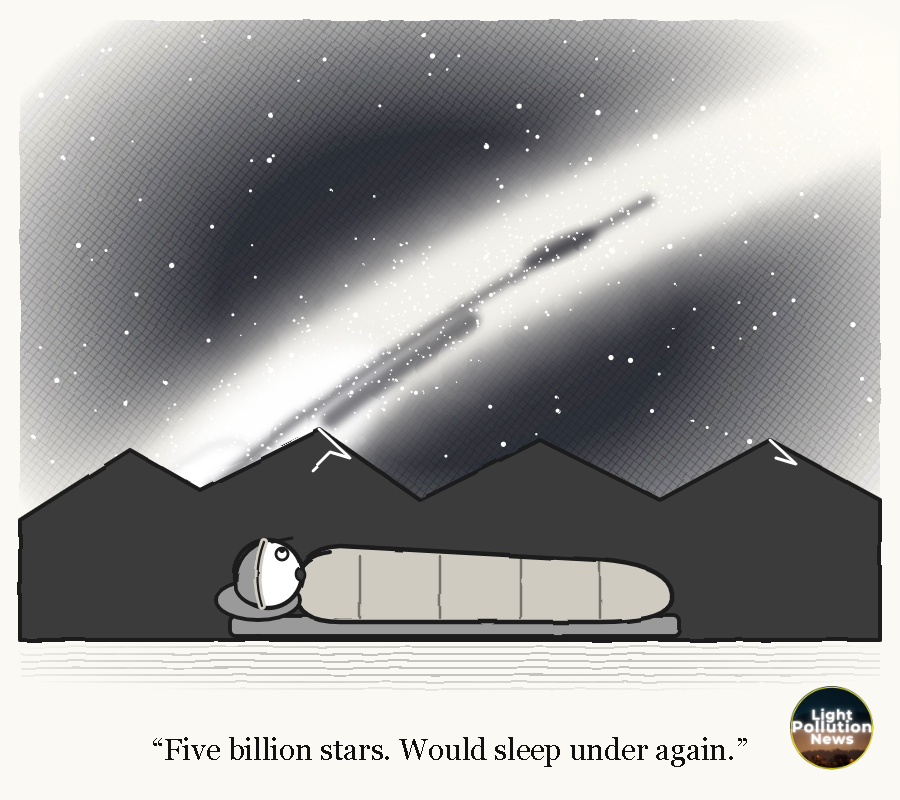
Many years back, I hiked the John Muir Trail, it’s a very popular long distance hike in California. We started that hike when daytime temps were still quite high. So I never bothered to put up a tent for the first 7 or 10 days. And there is truly something special about going to sleep and the last thing you see is the stars.
Well, if you need a suggestion of a good spot for this, why not visit Cherry Springs State Park, here in Pennsylvania. It is, without a doubt, one of the most unique park experiences on the planet. It’s a park model that I truly wish other places around the world would adopt.
The Pennsylvania Department of Conservation and Natural Resources took a victory lap recently as they celebrated their $5.2M investment in the starry sky park. You guys have heard me talk about this place previously. To recap for any new listeners, Cherry Springs State Park is a Bortle 2 – 3 area, with vibrant views of the Milky Way, and accessible for folks living in five large metro regions in the densest part of the US, and within reach from Southern Ontario. What makes it special is the fact that the park is built for night sky observing and astrophotography. This is a state park that provides the land and electricity to engage anyone with a telescope or a camera.
The $5.2M investment, while it isn’t without some failings, is still a pretty amazing and commendable moment. And I might add that it’s not just the stars that make this so alluring, come June, firefly season is both synchronized and intense.
Well, I guess, why visit a park when you might be able to sleep within view of the Milky Way every day? Located only 30 miles northwest of Little Rock, Arkansas, a community called Lakeview West may hold the answer for your starry skies dream.
The community was purposely built with no streetlights, and the houses were purposely built with exterior lighting aimed downward. It derives as the brainchild of Rick Ferguson, a developer in the region. According to this Arkansas Times article, the intent was to not have streetlights to allow folks full view of the night sky.
Now, these aren’t cheap homes, but they’re not terribly expensive. They sit around the $500K range, and 40 of them have thus far been sold.
Ok, before we go today. I have a piece of health news. Health news is always hard to fit in because, while it’s important to discuss, I feel like it just deadens the conversation. No one ever knows what to say when we cover health news.
With those motivating words in tow, here we go. A study out of the European Heart Journal asked whether light at night had any impact on the good old ticker (that’s your heart). The team used UK Biobank data to find individuals who wore a wrist light sensor, narrowing their subset to a group of roughly 11,000 individuals. These individuals didn’t have heart disease, didn’t work night shifts, and received a cardiac MRI generally about 3 years down the line. These individuals wore a wrist light sensor for a week sometime between 2013 and 2015.
The team didn’t capture how bright the light was. Instead, they counted the minutes during each person’s five least active hours when the light at the wrist was above 3 lux and the person may have been sleeping. From this study, the highest exposure group averaged around 34 minutes above 3 lux.
Now, that was a lot of lead up to get us to understand the results. Compared with folks who had no nighttime light above 3 lux, the highest exposure duration group had a roughly 2.4% greater left ventricle mass, 1.5% thicker heart walls (the thicker the walls, the heart must work harder), and 2% lower myocardial contraction fraction (how well the heart is pushing out blood). Shorter sleep statistically accounted for roughly a quarter to a half of the linkage between nighttime light and those heart measurements, which appears to indicate that most of the connection observed runs through something other than sleep.
The researchers also looked separately at a larger subset of the same UK Biobank data, roughly 73,000 people, who didn’t need an MRI. Compared those folks against individuals with no nighttime light above 3 lux and found that the highest-exposure folks faced a 29% higher risk of heart failure, plus a 33% higher risk for stroke and a 26% higher risk for cardiovascular death. It should be noted that the measure the team used did not identify brightness, just minutes over 3 lux. This study appears to add to the evidence pointing to artificial light at night having adverse health effects, but I want to stress, as that is the case, this study is not able to assign direct causation.
