

February 2026: Warm Yellow Richness, Light Pollution News
Join our mailing list. Follow us at LinkedIn, Instagram, Facebook, & Tiktok.
This Episode:
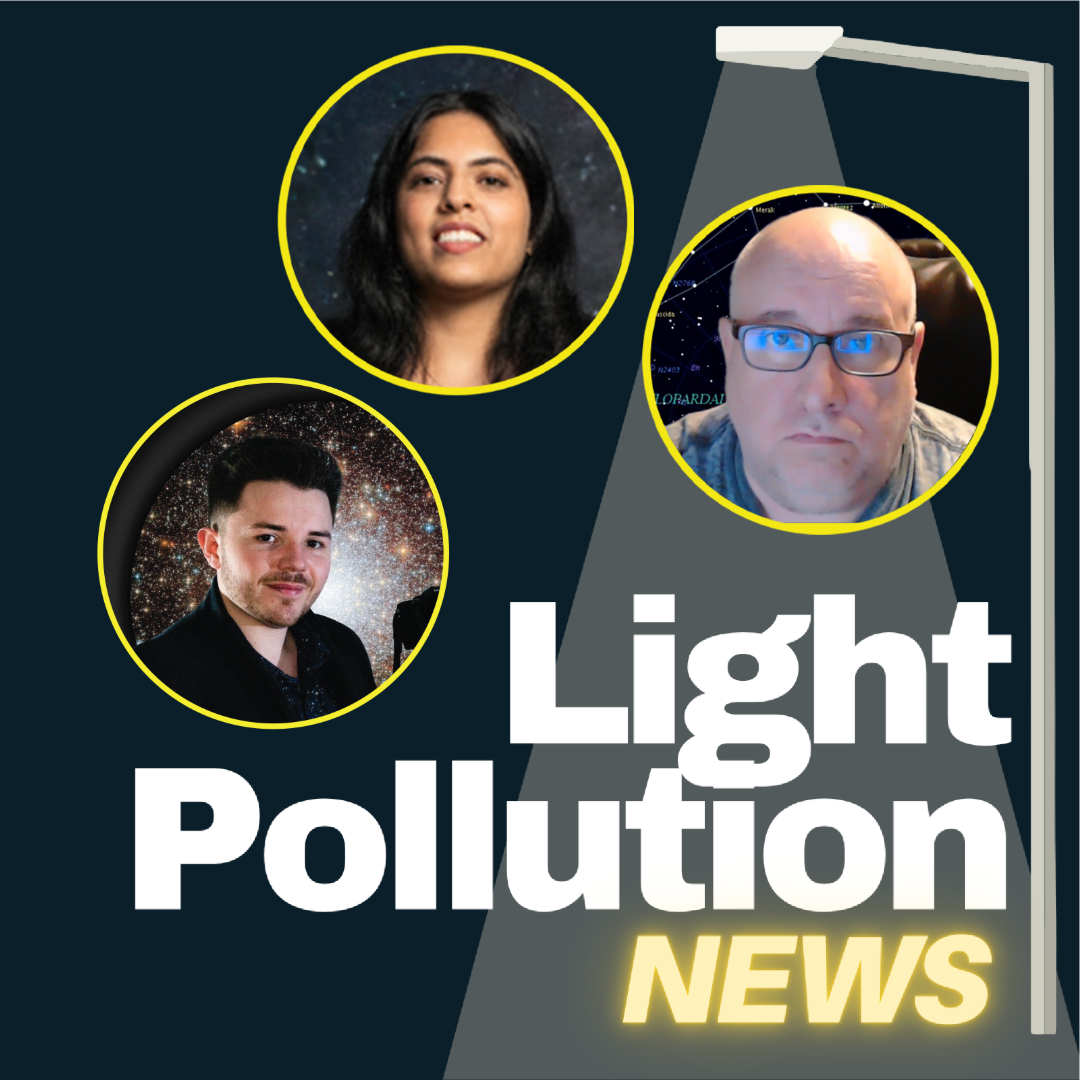
We have a great show for you today! Joining me today from AstronEra is Shweta Kulkarni; we have a return visit from one of my favorite nighttime photographers, Mr. Josh Dury; and joining all the way from across the Delaware, Dark Sky New Jersey’s Jim Webster.
This episode – did you hear, Maine has a new responsible lighting law! How are our feelings influenced by light. And…Dark Sky International released a design for a new car…yes, a new car. All this and more, coming right up in this episode of Light Pollution News!
Like What You See and Hear? Consider Supporting the Show.
A hearty thank you to all of our paid supporters out there. You make this show possible.
For only the cost of one coffee each month, you can help us continue to grow. That’s $3 a month. If you like what we’re doing, if you think this adds value in any way, why not say thank you by becoming a supporter!
Why Support Light Pollution News?
- Receive quarterly invites to join as a live audience member for recordings with special Q&A sessions post recording with guests.
- Receive all of the news for that month via a special Supporter monthly mailer.
- The satisfaction that your support helps further critical discourse on this topic.
Support Light Pollution News!
Host:

Guests:



Shweta Kulkarni
Shweta Kulkarni is an astronomer, entrepreneur, and pioneer of India’s dark sky movement. She became CEO of the Astron SHK Trust at eighteen while pursuing her BSc in Astronomy. She now directs AstronEra, an organisation dedicated to dark sky preservation that operates in over one hundred and twenty countries, collaborating with DarkSky International and government institutions.
Her work has earned grants from India’s Department of Science and Technology, Maharashtra’s Tribal Development Department, and the International Astronomical Union. Notable recognitions include her 2018 selection among India’s Top One Hundred Women Entrepreneurs, Fellowship of the Royal Astronomical Society, and the 2024 Dark Sky Defender Award Asia—making her the first Indian recipient.
Jim Webster
Jim Webster is an astrophotographer, dark sky advocate, and SciStarter Ambassador from New Jersey. After serving in the Air Force and working as a Verizon operations supervisor, he rekindled his childhood passion for astronomy in 2017, which led him to discover light pollution’s harmful effects. As a DarkSky Advocate with the International DarkSky Association, he educates communities at parks, libraries, and festivals about citizen science projects like Globe at Night and Marine Debris Tracker. Through Verizon’s partnership with SciStarter, he uses hands-on presentations with props like meteorite shards and ocean debris to make science accessible, helping establish a light pollution exhibit at Jake’s Branch County Park and inspiring others to turn curiosity into environmental action.
Josh Dury
Josh Dury Photo-Media AKA ‘Starman’ (B.A. FRAS), is an Internationally Acclaimed, Award-Winning Landscape Astrophotographer, Presenter, Speaker, Best-Selling Author and Writer from The Mendip Hills AONB in Somerset, United Kingdom. His images having received endorsements by NASA, APOLLO 11 Astronaut – Buzz Aldrin, The European Space Agency (ESA) + British Astronaut – Tim Peake, The World At Night (TWAN), PPOD, BBC & CBS amongst others. He also acts as a Delegate of Dark Sky International for Bristol, UK.
Full Article List:
- DarkSky One supercar lurks in the dark like a ninja with its sensible lighting, Gaurav Sood, Yanko Design.
- Colored light changes how music makes us feel, Eric Ralls, Earth.com.
- Bright needs, dark desires: Public preferences and balancing the benefits of artificial light and natural darkness at night in Aotearoa New Zealand, People and Nature.
- Denver Christmas Lights – Myth and Reality, Alejandro Hernández, Denver Public Library.
- Once the ‘Christmas Capital of the World,’ Denver Is Where Outdoor Holiday Lights Began, Stacy Nick, KUNC.
- These vintage-inspired string lights are here to fix the ‘blue’ Christmas problem, Grace Snelling, Fast Company.
- Flashback Dec. 1904: When Coronado lit the 1st electric Christmas tree in the U.S., Debbie L. Sklar, Times of San Diego.
- Light Up the Town, Steam.
- 132nd Maine Legislature, Second Regular Session, Maine.
- A plan to renovate public lighting to combat light pollution, Nice Premium.
- Illuminating Inequality: Public Lighting Energy Consumption and Light Pollution in Urban and Rural Contexts, Chemical Engineering Transactions.
- Evaluation of Urban Nighttime Light Environment Safety Using Integrated Remote Sensing and Perception Modeling, Remote Sensing
- Evaluations of nighttime lighting environments in commercial areas: a field study in Xinjiekou, Nanjing, Building and Environment.
Light Pollution News: January Highlights
DarkSky International Concept Car at Detroit Auto Show
DarkSky International unveiled a concept car at the Detroit Auto Show featuring strategically placed LEDs with adaptive lighting technology designed to minimize glare and reduce stress on wildlife. The automotive design showcases how vehicles can incorporate dark sky principles through innovative headlight systems that reduce light pollution impacts on oncoming drivers and nocturnal ecosystems. This concept car demonstrates the automotive industry’s potential role in addressing light pollution through thoughtful engineering and design innovation.
Lighting and Music Perception Research from Clemson University
Clemson University researchers conducted groundbreaking studies on how different lighting conditions influence human emotional responses to music. The study placed 22 adults in a sealed listening lab with adjustable LED fixtures, exposing participants to four lighting conditions, including warm white, cool white, red, and blue light, while rating one-minute music clips on emotional valence. Research findings revealed that warm white light produced the strongest positive feelings for happy music, while blue light emerged as the best match for sad music, with red light receiving the lowest ratings. This study, published in Lighting Design + Application, demonstrates the psychological intersection between lighting spectrums and human emotional perception.
Christmas Lighting History and Denver Mythology
Historical investigation reveals competing claims about the origins of outdoor Christmas lighting in America, with Denver and Coronado, California, both asserting primacy. Local Denver lore attributed the tradition to electrician D.D. Sturgeon supposedly stringing lights outside his terminally ill son or grandson’s window in 1914, but the Denver Public Library debunked this narrative, revealing that colored electric lights were used in Denver as early as 1896 and that Sturgeon never claimed to have invented outdoor Christmas lights. Coronado, California, claims they displayed the first tree still in the ground that was lit in 1904. Additionally, Colorado Springs created a wildlife-friendly holiday display in 1915 by stringing a large tree with bird feeders, representing an early intersection of holiday celebration and ecological consciousness.
Modern Holiday Lighting Technology and Light Pollution
Contemporary holiday lighting has shifted dramatically toward colder LED color temperatures, contributing to increased light pollution levels documented at up to 50% higher than previous studies, according to 2023 research. Companies like Tru-Tone are working to recreate the warm spectrum of vintage incandescent bulbs using LED technology with artificial filaments, addressing consumer demand for warmer holiday lighting aesthetics. Modern holiday displays, including installations at venues like the Philadelphia Zoo, often remain illuminated throughout the night, contributing significantly to urban light pollution despite technological advances in LED efficiency.
Maine Becomes First State with Comprehensive Light Pollution Legislation
Maine enacted historic light pollution legislation titled “An Act to Promote Responsible Outdoor Lighting,” becoming the first U.S. state to implement comprehensive lighting controls. The law, which became effective January 7th with implementation on October 1st, requires dimming of public lights after 10 p.m. until 7 a.m., mandates that nonessential lighting including signage and landscape illumination be turned off during nighttime hours, restricts light trespass to 0.1 lux on natural areas, and caps color temperature at 3000K. The legislation follows Illuminating Engineering Society (IES) guidelines and applies to new and replacement lighting on public property. However, exemptions include temporary roadwork, federally regulated roads and walkways, sports lighting, holiday lighting, ski areas, and historically protected buildings. The Maine Office of Community Affairs is developing model ordinances for municipalities wishing to adopt similar responsible lighting policies.
Alpes Azur Mercantour International Dark Sky Reserve Achievement
The Alpes Azur Mercantour region in France, designated as an International Dark Sky Reserve in 2019, has achieved remarkable progress in lighting conversion, reaching 56% conversion to dark sky-friendly street lighting as of recent reports, up from just 19% at the time of designation. This represents significant success in implementing responsible lighting practices across a protected natural area and demonstrates the feasibility of large-scale lighting retrofits in ecologically sensitive regions.
Energy Consumption Analysis and Light Pollution Measurement
A Chemical Engineering Transactions study examined light pollution through energy consumption data rather than traditional satellite imagery analysis, providing new insights into lighting patterns and their environmental impacts. The research assumed that 20% of public lighting consumption was electric and found that while total consumption ranged from under 10 megawatt-hours in small villages to over 1,000 megawatt-hours in large cities, per capita measurements revealed unexpected patterns. Sparsely populated rural settlements showed disproportionately high per capita consumption between 0.002 and 0.02 megawatt-hours per person, indicating that rural residents pay disproportionately more for their public lighting infrastructure, suggesting economic inequities in lighting distribution and costs.
Public Attitudes Toward Artificial Light and Natural Darkness
A comprehensive study published in People and Nature surveyed 1,000 New Zealanders to understand public preferences regarding artificial light at night versus natural darkness benefits. Researchers examined attitudes toward lighting benefits including traffic safety, property crime prevention, and personal safety in parks, compared against darkness benefits such as peace and solitude, stargazing opportunities, and protecting natural rhythms. Results showed that safety-related lighting benefits rated as “very important” while darkness benefits landed at “moderately important,” with no difference in darkness appreciation between urban and rural residents despite urban dwellers rating artificial light benefits higher. Notably, one-third of survey respondents favored motion-sensing street lighting, with even higher support for motion sensors in less critical applications like sports fields, suggesting public openness to dynamic lighting solutions.
Safety Perception and Optimal Lighting Levels in Chinese Cities
From Remote Sensing, the relationship between lighting levels and safety perception through comprehensive field measurements and surveys. Researchers measured lighting at 304 locations across three categories including roads, business districts, and squares, while surveying 2,306 people about safety perceptions. The study revealed diminishing returns in the relationship between brightness and perceived safety beyond certain thresholds. Optimal comfort levels were identified as 4 to 10 lux for roads, 5 to 38 lux for business districts, and 6 to 13 lux for squares—notably lower than China’s current national lighting standards. The wide ranges in optimal lighting levels suggest significant variability in individual perception and environmental context, indicating that current standards may result in overillumination without corresponding safety benefits.
Commercial Zone Lighting Analysis in Nanjing
Building and Environment journal published research evaluating nighttime lighting across seven commercial zones in Nanjing, China’s busiest shopping area. Researchers measured four main light sources including LED screens, commercial signboards, decorative facades, and advertising facades while surveying 179 pedestrians about visual experience. The study assessed nine lighting indicators and found that luminance from LED screens, signboards, and illuminated facades consistently exceeded recommended design thresholds. Analysis revealed that contrast-based metrics, which compare brightness differences between light sources and surroundings, were more effective predictors of human lighting perception than absolute brightness measures, suggesting that lighting quality and distribution patterns matter more than raw intensity levels in determining visual comfort and environmental quality.
Light Pollution News: January Read Along
How about this to start today’s show! DarkSky International released the design of a concept car at the Detroit Auto Show, which took place from January 14 to 25. There are no internal specs for this car, for which I assume DarkSky wasn’t trying to make a case to actually build a car, but rather point out some smart exterior features. For you at home who hasn’t seen this yet, it’s pretty slick. Utilizing strategically placed LEDs with adaptive lighting, DarkSky specifically wanted to bring into focus how light, specifically headlights, tends to create glare that could potentially impact oncoming drivers and create what they call “stress for wildlife.” The car seeks out some sort of automotive zen with the night, or as DarkSky says, ‘shaped so the night can breathe.’ Gaurav Sood, who wrote this piece for Yanko Design, had this great quote from the Batman movie, the ‘Dark Knight Rises,’ “You Merely adopted the dark. I was born in it, molded by it.” Kudos to Sood for an excellent placement, assuming he did that and it wasn’t AI Sood.
I was curious when I saw this out of Lighting Design + Application. The article looked at how lighting influences our experience with music. A team from Clemson University converted a university room into a sealed listening lab with adjustable LED fixtures. They put 22 adults in the room and forced them to spend 15 minutes adapting to one of four lighting conditions: warm white, cool white, red, and blue. The subjects then rated one-minute music clips on a ten-point scale for how positive the songs felt and whether the lighting matched their mood. For happy music, warm white light produced the strongest positive feelings. For sad music, red light received the lowest ratings, and blue emerged as the best match.
In keeping with the theme of light and emotion, I came across some interesting articles from Colorado back around Christmas. Local lore has it that an electrician by the name of D.D. Sturgeon strung up Christmas lights on a tree outside of his near-terminally ill son or grandson’s window. The claim to fame appears to be that outdoor Christmas lights began as a tradition in Denver in 1914. This was a story repeated by historian Julie Peterson, KUNC, a public radio station in the Denver area. However, the Denver Public Library cast doubt on the official narrative. Instead, they argue, that there’s no proof of this event ever taking place. In fact, colored electric lights were used in Denver starting in 1896, and D.D. Sturgeon never claimed that he invented outdoor Christmas Lights!
For you following at home, the boy would go on to survive his childhood illness. And there’s this interesting tidbit that I wish would actually make a comeback, sans the festive lights – in 1915, Colorado Springs strung up a large tree and put bird feeders in it to attract wildlife, something akin to a celebration of life in the spirit of the holidays.
I came across a piece from Fast Company, which talked about a business known as Tru-Tone. Before I go any further, I want to be clear that we here at Light Pollution News have no affiliation with Tru-Tone. However, this article and this product seemed relevant, so I wanted to make you at home aware of it. So indeed, holiday lights have become colder! In addition to adding to unforeseen levels of light pollution, up to 50% more per a 2023 study, holiday lighting now often lacks warmth. But Tru-Tone appears to be a rarity in today’s holiday lighting world. With purpose, they attempted to recreate the warmth of holiday lighting, but with LEDs and even a fake filament. This may not curb the light assault on the night, especially as places like, say, the Philly Zoo here, which keeps its decorative lights blazing bright straight through the night. However, these lights are magnitudes warmer than the current LED string lights on the market.
For the record, Denver isn’t the only city making the claim to have the first outdoor Christmas lighting. Coronado, California, for what it’s worth, claims that they did the same feat, only in 1904. I should caveat that the claim is that this is the first tree still in the ground that was lit. Since we’re here, I promise we’ll move on in a minute. Have you guys ever wished – boy, there’s one thing missing in my life. And you know what that is? It’s a Christmas light simulator! There was a new game called ‘Light Up the Town,’ that debuted in December on Steam. It’s literally your life as a ferret, set in the disputed birthplace of outdoor holiday lighting, Colorado, for which the only job you do is string up lights. No sleeping for this ferret!
In policy news, Maine became the first state to take a stand against light pollution. Though the final bill did get somewhat watered down, it still carries weight. The bill, officially titled “An Act to Promote Responsible Outdoor Lighting,” became law on January 7th, with an implementation date of October 1st. It only covers new and replacement lighting. It is also only applicable to public property. The law will follow the guidelines set out by the Illuminating Engineering Society (IES).
Here’s what’s included: Lights are dimmed after 10 p.m. until 7 a.m. (or sunrise). Buildings can hold off for one hour after closing to dim lights, provided it’s past 10 p.m. Lighting deemed nonessential (which includes signage and landscape) must be off during nighttime hours. Light trespass can’t exceed .1 lux onto a natural area. 3000K is the highest color temperature range.
Here’s what’s not included, buckle up friends. Roadwork, provided it’s temporary, is exempt. Roads and walkways under federal regulations. Local governments are not required to adopt their own responsible lighting policies, which was a consideration earlier. But the Maine Office of Community Affairs is developing a model ordinance for communities that choose to be responsible. Buildings protected by historical preservation laws are exempt. Most sports lighting and holiday lighting, and all ski areas are exempt.
In some good news, over in what I want to imagine to be a beautiful area, the Alpes Azur Mercantour part of France, which became designated as an International Dark Sky Reserve in 2019, recently boasted about a 56% conversion to, what I’m assuming are, dark sky friendly street lights. That’s up from 19% in 2019. Big movements!
And while we’re here in our policy news, a study out of Chemical Engineering Transactions looked at how energy bills painted the picture of light pollution, as opposed to defaulting to satellite imagery. The study assumed that 20% of the public lighting was electric. The team found that while total consumption ranged from under 10 megawatt-hours in small villages to over 1,000 in large cities, the per capita measurement ended up telling a different story. Several sparsely populated rural settlements showed disproportionately high per capita consumption, between 0.002 and 0.02 megawatt-hours per person, which suggests that these residents pay disproportionately more for their public lighting.
Let’s jump into the minds of the individuals. What do the average folk think about artificial light and darkness. In a study out of People and Nature, a team surveyed 1,000 New Zealanders to understand how folks balance their preferences for artificial light at night with their perception of natural darkness. Researchers asked participants to rate the importance of lighting benefits alongside darkness benefits. Lighting benefits in this case included traffic safety, so-called prevention of property crime, and so-called personal safety lighting in parks. Conversely, the benefits of darkness included things more intrinsic, such as peace and solitude, being able to see the stars, and protecting the natural rhythms of nature.
They found that, unsurprisingly, lighting deemed to be related to safety rated as “very important” while most of the benefits from darkness landed at “moderately important.” Despite urban residents ranking artificial light’s benefits higher, they showed the same level of appreciation for natural darkness as that of rural residents. Here’s what caught my attention, though, when asked about delivery modes of artificial light at night, a full third of those surveyed were in favor of motion sensing street lighting, with higher percentages on uses deemed more trivial, a la sports fields.
A study out of Remote Sensing asked, just how much light is needed for someone to feel safe? A team out of Dalian, China, gathered satellite imagery and utilized on-the-ground measurements to assess light levels. The team measured lighting at 304 locations, including three broad categories: roads, business districts, and squares. They surveyed 2,306 people about their perceptions of safety. They found that brightness and safety perception showed diminishing returns at a certain point, meaning that at some point, the light doesn’t make individuals feel safer. They found the following comfort levels: 4 to 10 lux for roads; 5 to 38 lux for business districts; and 6 to 13 lux for squares, which were notably lower than China’s current national standards. I will note that they were also quite wide ranging.
Out of Building and Environment, a team evaluated nighttime lighting in seven commercial zones within Nanjing, China’s busiest shopping area. They measured four main light sources, including LED screens, commercial signboards, decorative facades, and advertising facades. They surveyed 179 pedestrians about their visual experience. The researchers assessed nine lighting indicators and found that luminance from LED screens, signboards, and illuminated facades consistently exceeded recommended design thresholds. Their analysis showed that contrast-based metrics, which compare brightness differences between light sources and surroundings, were slightly more effective than absolute brightness measures at predicting how folks actually perceived the lighting environment.

