
January 2026: 0.68%, Light Pollution News
This episode, what did we learn when France decided to turn off its streetlights? Dark Sky Festivals can inspire more than admiration; they can inspire action! And where, exactly, should you put your bed at night?
Guest Lineup
Host
-

Bill McGeeney
Guests
-
Randy Nelson, PhD
Neurologist and Researcher
Nelson studies sleep and circadian rhythms in health and illness. For the past 15 years, his lab has focused on the role of disrupted circadian rhythms on physiology and behavior. He studies the effects of these disrupted circadian rhythms on several parameters, including immune function, neuroinflammation, metabolism, sleep, and mood. He has published nearly 500 papers and more than 12 books during his career, describing studies in biological rhythms, behavioral neuroendocrinology, stress, immune function, and aggressive behavior. He has been elected to Fellow status in several scientific associations, including the American Association for the Advancement of Science, American Psychological Association, Association for Psychological Science, and the Animal Behavior Society. Nelson has served on many federal grant panels and currently serves on the editorial boards of five scientific journals, as well as the Editor-in-Chief of the Journal of Experimental Zoology.
Dr. Nelson earned his AB and MA degrees in Psychology at the University of California, Berkeley. He earned a PhD in Psychology, as well as a second PhD in Endocrinology, both from UC Berkeley; he was the first in the US to simultaneously earn two PhDs. Dr. Nelson then completed a postdoctoral fellowship at the University of Texas, Austin, after which he joined the faculty at The Johns Hopkins University, where he was promoted to professor of Psychology, Neuroscience, Biochemistry, and Molecular Biology. He then served on the faculty at The Ohio State University from 2000 to 2018, during which time he served as Distinguished University Professor and Chair of Neuroscience, as well as the co-director of the Neurological Institute. Dr. Nelson was recruited to WVU in 2018 to serve as professor and inaugural chair in the new Department of Neuroscience. In addition to his NIH funding, he is Co-I of the $20M NSF Track 1 award, ‘West Virginia Network for Functional Neuroscience and Transcriptomics’. He has directly mentored 28 PhD and 16 postdoctoral colleagues.
See his new book, Dark Matters.
-
Rushil Kukreja
Founder of Princia
Rushil Kukreja is a senior at Thomas Jefferson High School for Science and Technology and serves as the Founder & President of Princia, the world’s largest student-run 501(c)(3) nonprofit tackling light pollution. He leads 260+ volunteers across 6 continents and has reached 13,000+ people through education and advocacy. His work has also been recognized by the $15,000 Christine Stevens Wildlife Award from the Animal Welfare Institute.
-
Scott Lind
Engineer
Scott Lind is a consulting electrical engineer with Mead & Hunt in Middleton, Wisconsin,
where he focuses on designing sustainable and reliable electrical systems for
commercial, industrial, and public facilities. With more than 35 years of experience,
Scott is passionate about designing outdoor lighting that respects all the other species we
share the planet with. He has a Bachelor of Science in Electrical Engineering (BSEE)
from Iowa State University and is a licensed professional engineer in Alaska and Wisconsin. Additionally, Scott is a LEED AP and holds master electrician and commercial
electrical inspector licenses in Wisconsin. He is the owner of Redshift Electric, a pro-bono electrical contractor focused entirely on improving outdoor lighting practices to reduce light pollution.

Summary
Light Pollution News: January Highlights
JPMorgan Chase Tower LED Installation Transforms NYC Skyline
JPMorgan Chase’s 270 Park Avenue headquarters rises 1,388 feet with 20,000 LEDs creating a large-scale illuminated display visible across New York City’s five boroughs. The $3 billion structure may be subject to 2020 NYC Energy Conservation Code requiring facade lighting deactivation between midnight and 6 AM.
Global Municipal Lighting Strategies
Cerema research documented French municipalities reducing public lighting through systematic deactivation programs throughout 2024-2025. Conversely, Canadian cities deployed extensive bright LED street lighting, though CBC reports declining nighttime social activity linked to generational behavioral shifts rather than illumination levels.
Residential Light Intrusion and Urban Skyglow Patterns
Urban Climate research examined bedroom light distribution in urban environments. Findings revealed maximum light accumulation 1-2 meters from windows, not at window edges. Urban residents experience significantly greater skyglow than suburban populations, even during clear conditions. Scientists recommend positioning beds below windowsill height and orienting bedrooms away from dense urban development.
Cardiovascular Health and Nighttime Light Exposure
Boston Longitudinal Study
Massachusetts General Hospital tracked 450 Boston-area adults over ten years using satellite-based light exposure modeling. Results presented at American Heart Association’s 2025 Scientific Sessions showed each standard deviation increase correlated with 35% elevated heart disease risk over five years and 22% over ten years. Dr. Shady Abohashem’s unpublished research suggests neurological stress responses trigger immune activation, potentially causing chronic vessel inflammation.
UK Biobank Analysis
BMC Public Health examined 391,549 individuals aged 37-73 using satellite nighttime brightness data. Highest exposure groups experienced 17 times greater illumination than lowest cohorts. Cardiometabolic disease incidence increased 7-11% in brightest conditions, with 8-16% elevated secondary disease risk. Data suggested dose-response relationships between light intensity and multi-disease development.
Digital Economy and Cognitive Performance
BMC Public Health research involving 53,164 participants across 112 Chinese cities examined light pollution relationships with digital economy expansion. Findings indicated inadequate light pollution management correlates with cognitive performance decline, though methodology limitations exist.
LED Technology Health Considerations
Contemporary LEDs utilize narrow spectral bandwidth differing substantially from broad-spectrum sources. Research citing Glen Jeffrey at University College London suggests concentrated spectrum output may produce adverse health effects.
Dark Sky Festivals and Conservation Education
York St. John University examined 94 Dark Sky Festival participants at North York Moors National Park using four activity categories: moorland walks, stargazing, observatory sessions, and silent disco experiences. Attendees navigated without flashlights using night vision, reporting emotional responses including humility, awe, and relief. Many recognized urban brightness levels for the first time, prompting residential mitigation intentions. Park officials noted festivals evolved from revenue tools into conservation education platforms.
Skiri Pawnee Celestial Cartography
Adrian Villellas documented 17th-century elk hide star charts from Skiri Pawnee people inhabiting Great Plains regions. The hide displays dense stellar fields resembling Milky Way patterns with constellations reflecting Pawnee-specific celestial interpretations rather than Western frameworks. Contemporary analysis suggests ceremonial educational applications versus navigational instrumentation.
Full Article List:
- New York’s Skyline Has a Bold New Look, Nicholas Mancall-Bitel, New York Times.
- Switching off public lighting: a study on local authority practices, Samuel Busson, Cerema.
- People nowadays are reluctant to stay out late. Is it killing nightlife?, Catherine Zhu, CBC.
- Computed indoor light conditions due to outdoor skyglow at night, Urban Climate.
- Exposure to more artificial light at night may raise heart disease risk, American Heart Association.
- Association between nighttime light and cardiometabolic multimorbidity: a prospective cohort study of UK Biobank, BMC Public Health.
- Digital dawn or dimming dusk? the dual impact of light pollution and digital economic expansion on senior cognitive function health in China, BMC Public Health.
- Are LED Lights Bad for You? The Hidden Health Impacts of Our Indoor World, Susannah Shmurak, The Upside.
- ‘My Neighbor’s Christmas Lights Shine into My Bedroom, What Should I Do?, Philadelphia Inquirer.
- Reaffirming sensory ethnography: sensing regenerative tourist practices in dark-sky protected zones, Journal of Sustainable Tourism.
- Ancient star chart that maps North American skies continues to baffle scientists, Adrian Villellas, Earth.com.

Have thoughts about today’s episode?
Why not Submit a Voicemail!
Or join our Mailing List or Substack?
Like What You See and Hear? Consider Supporting the Show.
For only the cost of one coffee each month, you can help us continue to grow. That’s $3 a month. If you like what we’re doing, if you think this adds value in any way, why not say thank you by becoming a supporter! Light Pollution News takes no outside advertising money and is 100% supported by its listeners.
Light Pollution News: January Read Along
Let’s kick things off. New York City christened a new tower to its garden of steel. The building, which is home to JPMorgan Chase’s corporate headquarters, sits at 1,388 feet tall and, according to the New York Times, shoots out like a ‘gargantuan lighthouse.’ The lighthouse effect derives from the estimated 20,000 LEDs used to create a visual art board towering out of the forest of skyscrapers.
And if you haven’t seen videos of this, it’s quite ostentatious, borderline dystopian – though many have embraced its visual displays as adding to the diversity of the NYC skyline. The tower’s upper third is essentially lit up to have some object, color, or otherwise design-ish looking thing going on. Judging by videos on Tiktok and Reddit, it’s not dim in the slightest, and is designed to be visible from much of the five boroughs.
The building, which cost an estimated $3B to erect, may be subject to the 2020 New York City Energy Conservation Code, which states that the facade lighting must be turned off between midnight to 6 am, but I couldn’t find any sources that confirmed that.
Scott, I’m going to start off with a story that you suggested. This is something that we saw throughout much of 2024 and 2025. ‘Switching off public lighting: a study on local authority practices.” This report charted communities in France that switched off their street lights.
Well quite the opposite of switching off the public lights, many cities in Canada, including all of the ones I’ve visited recently, utilize bright LED street lights. So, naturally, I wouldn’t fault you at home if you thought the opposite of what I’m about to tell you. Per the CBC, there appears to be a downward trend in night life in major Canadian cities.
This article doesn’t mention lighting once, but rather indicates what many of us know, and that is the younger generations, including people close to your age, Rushil, are simply more responsible human beings at a younger age than any of us who came before you, or maybe you’re just clever at your vices.
Here’s a great transition piece that I came across this week on social media, via the Philadelphia Inquirer. ‘My Neighbor’s Christmas Lights Shine into My Bedroom, What Should I Do?’, and in typical fashion, the editors put the onus of responsibility on the person affected by the lights shining into their bedroom, rather than suggesting that the perpetrator simply utilize some responsible restraint… i.e., turn the lights off at 10 pm and be considerate to your surroundings. But no, it’s always a shaming ritual to seemingly shut up the person complaining.
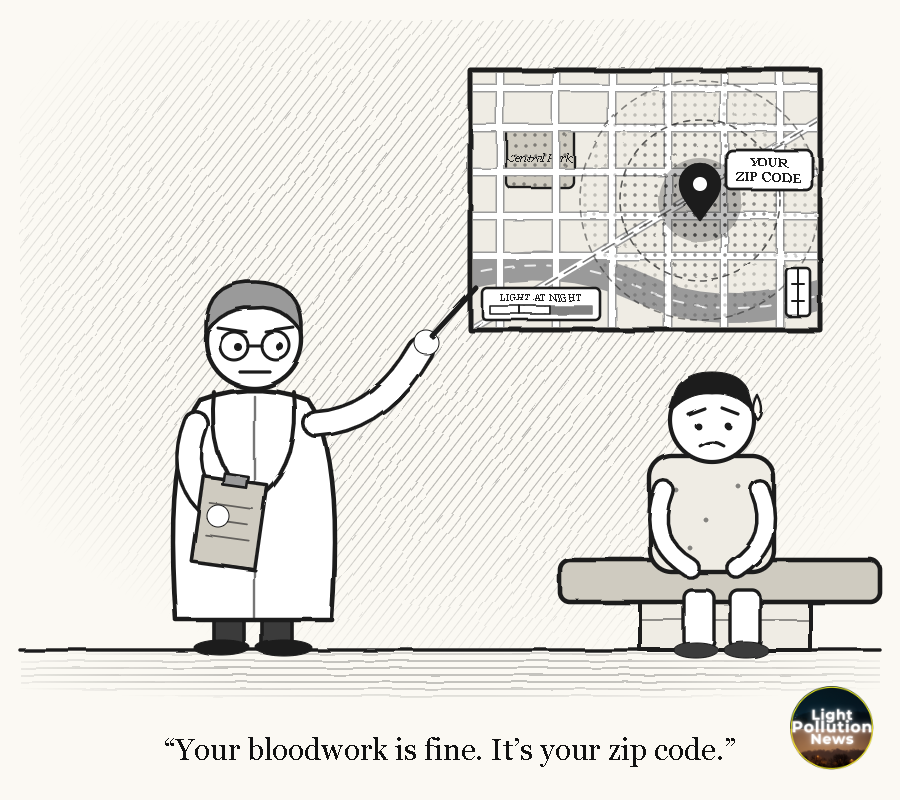
A study, out of Urban Climate, didn’t measure the quantity of light that enters your bedroom in an urban nighttime environment, but rather how and where that light tended to fall in the room. Anyone living in an urban area is probably well aware of the fact that on unclear nights, the sky brightness is rather significant and can actually light up your room quite a bit – I speak from experience here.
The study confirmed that urban dwellers experience much more skyglow effects at night than suburban folks, even on clear nights (for which this study assessed). However, when assessing where that light tended to accumulate, they noted that, given the typical geometry of a window, the maximum amount of light tended to sit 1-2 meters in from the window, not next to the window. The team suggested that city dwellers take advantage of this by placing their sleeping arrangements at a lower level than their windowsill and keeping beds in rooms that face away from the densest parts of the urban environment.
Last month, at the American Heart Association’s Scientific Sessions 2025 conference, Dr. Shady Abohashem presented a study abstract of an observational look at 450 healthy adults living in the Boston area for a time span of 10 years. During that time, researchers from the Massachusetts General Hospital assessed the participants, utilizing a generalized model of light at night exposure based on satellite data. The effect appeared to be that for each increase in a standard deviation of light exposure (definition of what entails a standard deviation not noted here), individuals had a 35% higher risk of heart disease over 5 years, and a 22% higher risk over ten years. Through to the follow up period, 17% of participants experienced major heart problems.
I will note that this study has not been peer reviewed and thus not published yet. Dr. Abohashem suggested that the brain may be perceiving stress and thus triggering an immune response, potentially inflaming blood vessels over time.
This study came from BMC Public Health, looking at 391,549 individuals between 37 and 73 years of age from the UK Biobank data. The study filtered out individuals with preexisting health concerns, including diabetes, heart disease, and stroke. To assess exterior light pollution levels, they utilized a general nighttime brightness assessment via satellite data.
Their results found that folks with the brightest nights were exposed to 17x more light at night outdoors than the lowest group. And of that brightest night cohort, cardiometabolic disease incidents rose by 7-11%. If an individual had contracted one disease, those living in the brightest nights had an increased risk for developing a second disease by 8-16%. And overall, researchers tried to pin the more intense the light exposure, the higher the risk of developing multiple diseases.
For you at home, the key takeaway may not be those percentages, but rather that while the team did their best to adjust for confounding variables, other unstudied factors may be at play, as well.
From BMC Public Health, a team studied 53,164 individuals aged 45 and up across 112 Chinese cities. The study utilized a general assessment of nighttime brightness via satellite data with the hopes of understanding the roles of light pollution and the growth of the corresponding digital economy, think cell phone usage, telecommunications, etc. Researchers found that, for all of its benefits, an externality of the digital economy is its lagging recognition and management of light pollution’s effect on individuals, which they asserted, rather vaguely, I might add, that this harms cognition. The study did test individuals on their cognitive abilities, but in my estimation may have tried to bridge too wide a data gap for the analytical design.
This one I want to run by you, Dr. Nelson. LED lightbulbs these days utilize a rather focused frame of bandwidth to generate the colors we see. Are you aware if LED lightbulbs are unhealthy? This question was raised in an article from earlier this year, which argued that LED lights being so narrow spectrum could have detrimental effects on our health, citing Glen Jeffrey from the University College London.
Switching gears, we’ll close out today with some cultural items.
A study came out this past fall by researchers at York St. John University who looked at how participants’ attitudes were (if at all) affected by Dark Sky Festivals. They sampled 94 visitors, along with 8 small business folks who helped organize the events, and two park officials from North York Moors National Park in England. They specifically looked at their experiences in one of the following activities: a moorland walk, an outdoor stargazing session, an indoor observatory session, and a moorland walk with silent disco. The team gathered their data via side by side walks with participants and utilizing a GoPro camera.
As it pertained to the visitors, the tourists walked in darkness without flashlights and utilized night vision. In addition, the walk was silent, to allow for nature’s noises to be clearly heard. Participants were reported to be affected in a myriad of ways, including gaining a sense of “humility”, “awe” and “wonder”, “relief”, and a realization of how bright cities were. This prompted some to mention that they may look to do light pollution mitigation at their house by switching to timers, for example.
Park officials referenced that the dark sky festivals have evolved away from purely a revenue tool, growing into a powerful conservation tool.
How about this, we can close out today’s show with an interesting piece from Earth.com by Adrian Villellas. I liked this one, but I really love all of this archeo-astronomy, per se. Adrian documented a 17th century elk skin star chart from the Native American people, the Skiri Pawnee. For you at home who are unfamiliar with the Pawnee, they were an ethnicity of Native Americans who lived in the Great Plains. And for you on the East Coast of the US, the Pawnee should not be confused with the Shawnee, of which the latter were an Algonquian speaking people, while the Pawnee, with a ‘P,’ were a Caddoan speaking people.
The elk skin showcases a dense star field, similar to the Milky Way, with surrounding constellations on either side. It should be noted that while some of these can be identified easily based on Western constellation lines, there are many that align more to a Pawnee understanding of the nighttime sky, so constellation alignment may be skewed. Initially, researchers viewed this skin as an astronomical tool, akin to a vintage planisphere. However, it appears that such a skin was probably used for ritual education.
